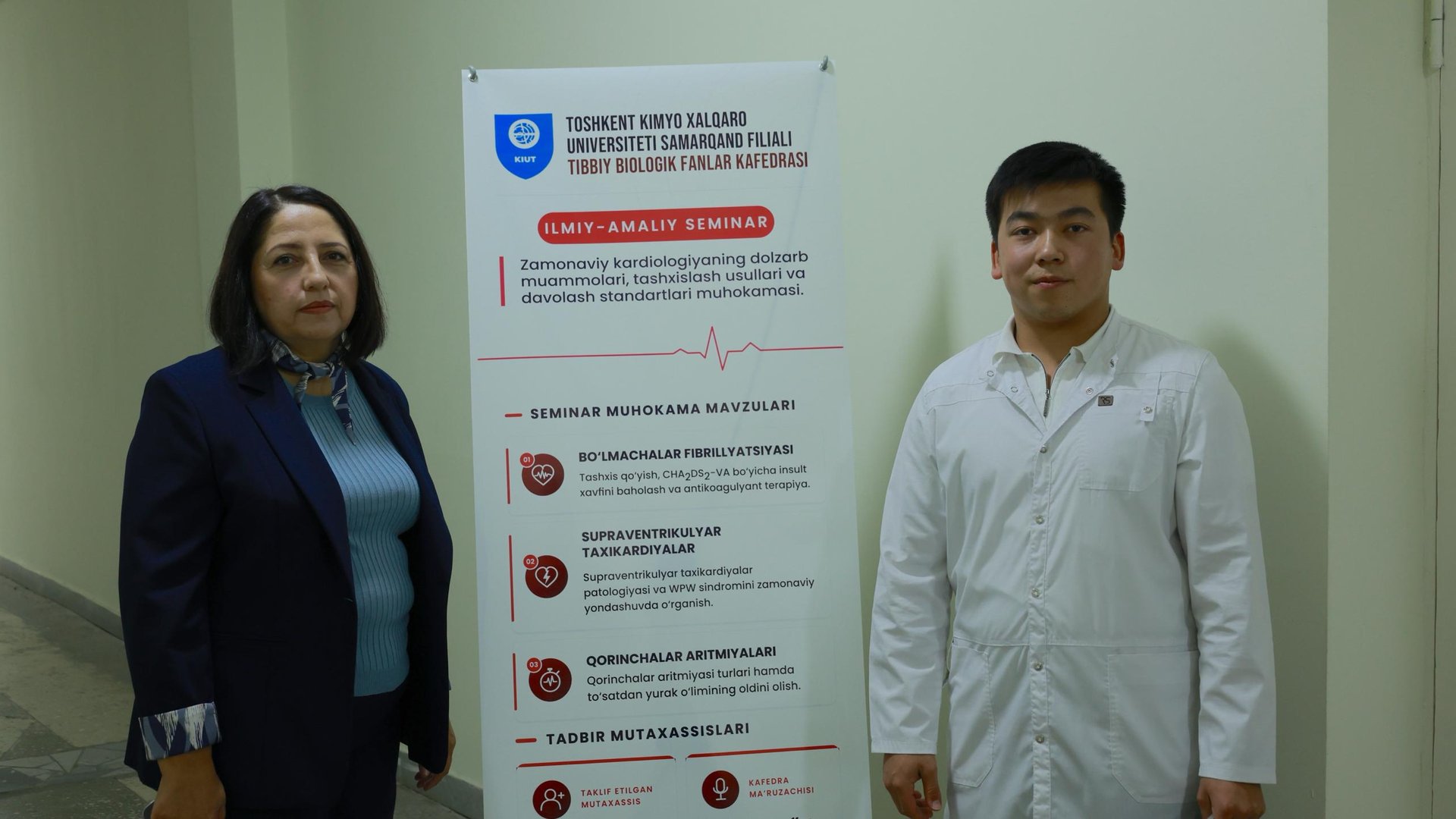
Behind the Secrets of Heart Rhythm: Future Doctors Explore Current Issues in Cardiology
Today, a scientific and practical seminar entitled “Atrial Fibrillation: Diagnosis, Stroke Risk Assessment (CHA₂DS₂-VA), and Anticoagulant Therapy. Supraventricular Tachycardias and WPW Syndrome. Ventricular Arrhythmias and Sudden Cardiac Death” was organized at the Samarkand Branch of Kimyo International University in Tashkent, at the initiative of the Department of Medical Biological Sciences.
The main objective of the seminar was to deepen future doctors’ theoretical knowledge of cardiac rhythm and conduction disorders, expand their practical understanding of modern diagnostic and treatment methods, and familiarize them with clinical approaches that play an important role in the prevention of cardiovascular diseases.
The event was attended by I. Khamidov, a specialist from the Samarkand Regional Branch of the Republican Specialized Scientific and Practical Medical Center of Cardiology, who delivered a comprehensive lecture on the seminar topic.
During the lecture, the speaker provided detailed information about the causes of atrial fibrillation, its clinical manifestations, diagnostic criteria, stroke risk assessment using the CHA₂DS₂-VA score, and the importance of anticoagulant therapy. In addition, modern medical approaches to the diagnosis and management of supraventricular tachycardias, WPW syndrome, and ventricular arrhythmias, as well as the prevention of sudden cardiac death, were discussed.
Students also actively participated in the seminar, presenting their own research and presentations and highlighting important aspects of the subject. In particular:
🔹 Jorakulova Khadichabonu — a student of Group 124, General Medicine Programme.
Topic: “The Cardiac Conduction System: Anatomical and Physiological Foundations — The Key to Understanding Arrhythmias.”
🔹 Jumaboyev Laziz — a student of Group 224, General Medicine Programme.
Topic: “Automaticity, Conduction, and the Mechanisms of Arrhythmia Development.”
The students’ presentations contributed to a deeper scientific understanding of the cardiac conduction system, its physiological characteristics, the mechanisms underlying heart rhythm formation, and the causes of various types of arrhythmias.
At the conclusion of the seminar, participants exchanged views on the topics discussed, and students had the opportunity to ask questions and receive answers from the specialist. Particular emphasis was placed on the importance of integrating theoretical knowledge with clinical practice in developing the professional competencies of future medical specialists.
This scientific and practical seminar served as an important step towards developing students’ clinical reasoning skills, enhancing their awareness of advances in modern cardiology, and strengthening cooperation between higher education institutions and practical healthcare organizations.